Episode 1
How the First Punic War began, 264 to 262 BC
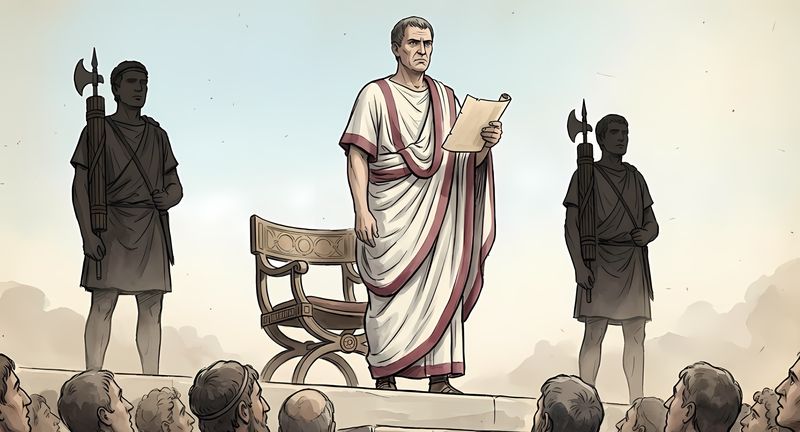
In 264 BC the Mamertines, Italian mercenaries holding the Sicilian city of Messana, asked Rome for help. Polybius says the Senate would not sanction it. The people voted for it, and for the first time a Roman army crossed the sea from Italyn.1. n.1 Polybius dates his whole history from this moment: “the first occasion on which the Romans crossed the sea from Italy” (1.5.1). This first episode follows that decision, and Hiero II of Syracuse, to the siege of Agrigentum in 262 BCn.2. n.2 The losses at Agrigentum come from Diodorus. The rest of the episode follows Polybius.
For tonight
The First Punic War, narrated for sleep
All twenty-four years in one slow reading, for the lights off. 1:07:54.
What Polybius says happened
Polybius, Histories 1.10 to 1.19, in Paton’s translation. The episode keeps this order.
The Mamertines of Messana, in trouble at home, split: some offered their citadel to Carthage, and others sent to Rome asking for help as a kindred people.
1.10.1 to 1.10.2
Even at the end the Senate would not sanction it. Worn out by recent wars and promised plunder by the commanders, the people voted to send help.
1.11.1 to 1.11.2
Appius Claudius, one of the consuls, was ordered across. In Messana the Mamertines turned the Carthaginian commander out of their citadel, and Appius crossed the straits by night and entered the city.
1.11.3 to 1.11.9
Hiero of Syracuse joined Carthage against him. Appius beat the Syracusans first, then the Carthaginians, and laid siege to Syracuse itself.
1.11.7 to 1.12.4
The next year both consuls came out with the whole army. Most Sicilian cities went over to Rome, and Hiero made a treaty, paid a hundred talents, and became Rome’s ally.
1.16.1 to 1.16.10
Carthage made Agrigentum its base. After some five months at a standstill, a relief army under Hanno and a battle between the camps, Hannibal broke out by night, and at daybreak the Romans took the city.
1.17.5 to 1.19.15
What is contested
- No independent re-check of this episode against Polybius is on record yet; the check of Episode 2 on 21 June 2026 is the model, and this entry will record the result.
See also
The corvus and the Battle of Mylae: how Rome built a navy, 260 BC
Four years on, Rome is winning in Sicily, and every Carthaginian fort still standing there is supplied from the sea.
The next episode
27:43
Sources and chapters
Rests on
- Polybius, Histories 1.7 to 1.20, translated by W. R. Paton (Loeb Classical Library, 1922); the quotations checked against the Loeb text
- Diodorus Siculus, Library of History, Book 23: the casualty figure at Agrigentum
Chapters
Every text these films use, with its translation.
Chapter times as published with the video; each opens it on YouTube at that point.