How an entry is made
The Chronos Catalog is my channel: long documentaries and sleep narrations about the ancient Mediterranean, made by one person. This page sets out what each piece is built from, how I check it, and which parts are made by software, so you can judge what you are watching.
The texts and translations
Every entry lists its ancient texts with the translation used, so a claim can be checked against the same page. These are the texts behind the six entries so far.
| Text | Translation used | Entries |
|---|---|---|
| Polybius, Histories, Books 1 to 3 | W. R. Paton, Loeb Classical Library, 1922 (read in the LacusCurtius text); Evelyn S. Shuckburgh, 1889, checked against Paton | 2026.2, 2026.3, 2026.4, 2026.6 |
| Diodorus Siculus, Library of History, Book 23 | none recorded; used for the casualty figure at Agrigentum | 2026.2 |
| Pliny the Elder, Natural History 16.192 and 35.166 | none recorded for the sixty-day fleet (16.192); the Bostock translation, quoted at second hand, for the volcanic ash of Puteoli (35.166) | 2026.3, 2026.5 |
| Cicero, On Old Age 44; Verrines | none recorded; used for the honour voted to Duilius (On Old Age) and Hiero’s grain tithe (Verrines) | 2026.3, 2026.4 |
| Vitruvius, On Architecture 2.6 | the Morgan translation, 1914 | 2026.5 |
| Jackson et al., American Mineralogist, 2017; Seymour et al., Science Advances, 2023 | published in English; the modern studies of Roman marine concrete | 2026.5 |
One early piece, entry 2026.1, went out without a sources line, and I have no record of which translation its script used. Its entry admits the gap rather than guessing.
How a piece is checked
I check the history against those texts before a piece is recorded. Quotations are copied from the translation and compared word for word. Where the ancient accounts disagree, or modern historians doubt a figure, the narration flags it aloud, and its entry lists the point under Contested.
When something is wrong
Errors found after a piece is published go into the corrections ledger with the date found, the date fixed, and what changed. If you find one, the address above is the place to send it.
Dates are worked out from one fixed chronology of the war, never from each other. An early draft of Episode 2 called 260 BC the second year of the war; against that chronology it is the fourth, and the line was corrected before the episode was published.
The chronology is the table of years on the series page, each year with its chapters of Polybius.
That same check of Episode 2 against Polybius, on 21 June 2026, made seven corrections before release, including the one that had called the man who drafted the fleet a Roman. Polybius names no shipwright, and the skill came from Rome’s Greek allies.
Errors caught before release are not in the ledger. It lists only what went out.
What software makes, and what it does not
Voice. The narration is a synthesised voice, not me reading. The six pieces published so far were narrated with Kokoro, a text-to-speech model, and the Polybius quotations in the First Punic War episodes use a second Kokoro voice so that the ancient text sounds apart from the narration. A voice model trained on my own recordings is being used for pieces now in production; when one is published, its entry will say which voice it uses.
Each entry’s record names its voice, beside the date it was entered and its runtime.
Drafts. Scripts are drafted with AI writing tools under my direction, and I approve each one before anything is recorded. The checking against the sources is mine, as described above.
Pictures. Illustrations are generated with Google’s Gemini image model from written briefs, one brief per scene, and checked against reference drawings before they are used. Those references fix the details a period reader would catch: mail shirts and oval shields for the Roman legions of the third century BC, deep blue for Carthage and red for Rome, and the corvus built the way Polybius describes it. His description is exact enough to draw from (1.22.4 to 1.22.7). A pole four fathoms high stands on the prow; the gangway is four feet wide and six fathoms long, with a rail as high as a man’s knee on each side and an iron spike at the far end.
His whole description, in Paton’s words, is on the first page, numbered to a drawing of the corvus.
Music. An entry names its music only where the record is confirmed. So far one does: 2026.4, Between the Wars, runs over a slow string drone I composed.
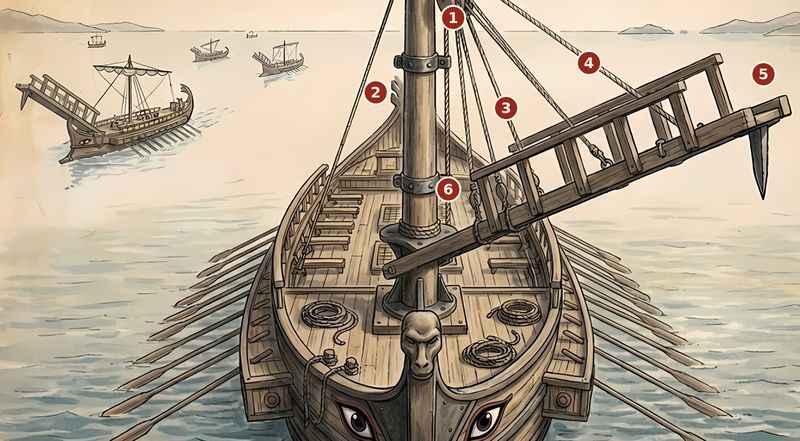
The six parts, as the card numbers them
- A pulley at the top of the pole: one block.
- One fibre rope only, run over the pulley to raise and lower the gangway.
- A plank gangway, about 36 feet long and 4 feet wide, all of wood.
- A low wooden rail, knee high, on both long edges.
- A heavy iron beak under the outer end, pointing down like a crow’s beak.
- A pole about 24 feet high at the bow; the gangway slots round it, hinges down and swings from side to side.
What sent a picture back
- No chains, gears, winches, cranks or cogs.
- No metal drawbridge: the walkway is wood, the beak is iron.
- No crane arm or shipyard crane.
- No beak drawn as a huge cone or a ball.
- No pole through the middle of the gangway: it runs to the base.
- No modern element, no text, no labels.
The card’s own shorthand for the second list: “these = redo the shot”.
The plates
Every picture on this site is generated, as set out above, and each has one number wherever it appears.
- IThe corvus, keyed to Polybiusthe first page
- IIA small boat at night, standing in for the first nightentry 2026.1
- IIIThe Rostra: the vote read outentry 2026.2
- IVThe captured ship on the beachentry 2026.3
- VThe river mouth before dawnentry 2026.4
- VIRoman concrete in sectionentry 2026.5
- VIITwo fleets on one coastentry 2026.6
- VIIIOne pair at MylaeThe First Punic War
- IXHarbour piers in the surfThe Chronos File
- XThe harbour at nightSleep to Antiquity
- XIThe corvus reference cardthis page
The letters set on a plate key it to the passage printed beside it.
The Chronos Dispatch
One email when a new entry is filed, with the source notes that did not fit in it.