Films on Rome, Carthage and Roman engineering, set beside the ancient texts they start from.
Documentaries told from Polybius and Vitruvius, and long narrations of the same history for sleep. Each entry names the texts it rests on and the translation where one is on record. One early sleep narration went out without a sources line, and its entry says so.
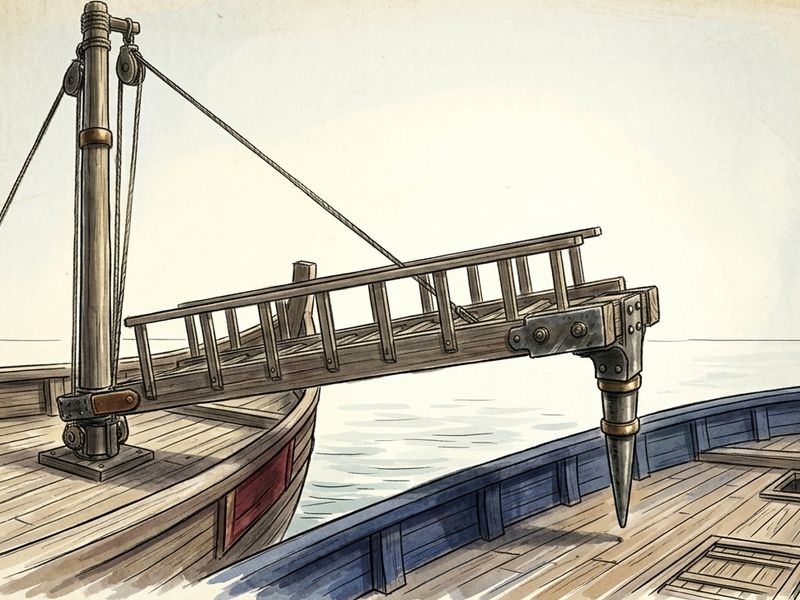
The corvus, as Polybius gives it
1.22.4 to 1.22.8, translated by W. R. Paton
- a“On the prow stood a round pole four fathoms in height and three palms in diameter.” 1.22.4
- b“This pole had a pulley at the summit” 1.22.5
- c“and round it was put a gangway made of cross planks attached by nails, four feet in width and six fathoms in length.” 1.22.5
- d“In this gangway was an oblong hole, and it went round the pole at a distance of two fathoms from its near end.” 1.22.6
- e“The gangway also had a railing on each of its long sides as high as a man’s knee.” 1.22.6
- f“At its extremity was fastened an iron object like a pestle pointed at one end and with a ring at the other end” 1.22.7
- g“To this ring was attached a rope with which, when the ship charged an enemy, they raised the ravens by means of the pulley on the pole and let them down on the enemy’s deck” 1.22.8
The register
Six entries so far, in three series.
Rome and Carthage at war for Sicily, from Polybius. Two of five episodes are published.
| No. | Title | Entered | Runtime | Rests on |
|---|---|---|---|---|
| 2026.2 | How the First Punic War began, 264 to 262 BCSee also The First Punic War, for sleep | 23:37 | Polybius 1.7 to 1.20; Diodorus, Book 23 | |
| 2026.3 | The corvus and the Battle of Mylae: how Rome built a navy, 260 BCSee also Ecnomus, for sleep | 27:43 | Polybius 1.20 to 1.24; Pliny, Natural History 16.192 |
One mechanism per film, followed from the ancient text to what modern engineering now says about it.
| No. | Title | Entered | Runtime | Rests on |
|---|---|---|---|---|
| 2026.5 | Roman concrete and seawater: why the harbours still stand | 13:28 | Vitruvius 2.6; Pliny, Natural History 35; Jackson et al. 2017; Seymour et al. 2023 |
Long, unhurried narrations of the same history, written to be heard with the lights off.
| No. | Title | Entered | Runtime | Rests on |
|---|---|---|---|---|
| 2026.1 | The First Punic War, narrated for sleepSee also Episode 1: how the war began | 1:07:54 | No sources line was published with it | |
| 2026.4 | Rome and Carthage between the wars, narrated for sleepSee also The First Punic War, for sleep | 1:34:07 | Polybius, Books 1 to 3; Cicero, Verrines | |
| 2026.6 | The Battle of Ecnomus, 256 BC, narrated for sleepLatest entry. The summer of 256 BC off the south coast of Sicily, told slowly. By Polybius’s reckoning of the crews, close to three hundred thousand men were at sea; some historians think the figure too large, and the narration flags the doubt as it goes.See also Episode 2: Rome builds a navy | 1:01:53 | Polybius, Book 1 |
A passage and its notes
“...running aground fell into the hands of the Romans. This ship they now used as a model,n.1 and built their whole fleet on its pattern...”n.2
Sources and checking.Each entry lists its texts with the translator and edition, and a person checks the history against them. Where the ancient accounts disagree or a figure is doubted, the piece says so.
Made with software.The narration is a synthesised voice, not a person reading: all six pieces so far were voiced by Kokoro, a text-to-speech model. Illustrations come from Google’s Gemini image model, generated from written briefs and checked against reference drawings for period detail.
From the ledger, C-03, open since : a Short on the same fleet
Rome built the fleet in four months. No ancient source gives four months. Polybius gives no time at all.
Notes on the passage
- n.1 Polybius names no shipwright. He calls the Roman shipwrights “absolutely inexperienced in building quinqueremes” (1.20.10), and the first crossing was made in boats borrowed from Tarentum, Locri, Elea and Naples (1.20.14).
- n.2 † The fleet built in sixty days is not in Polybius either. It is Pliny’s tradition of a fleet afloat on the sixtieth day after the timber was felled (Natural History 16.192), and Episode 2 gives it as such.
The Chronos Dispatch
One email when a new entry is filed, with the source notes that did not fit in it. Nothing is written to fill a schedule. This is the kind of note it carries:
Polybius gives the corvus in fathoms: a pole four fathoms high and a gangway six long (1.22.4 to 1.22.5). In feet that is about twenty-four and thirty-six, the figures on the card every corvus in Episode 2 was drawn against.