Episode 2
The corvus and the Battle of Mylae: how Rome built a navy, 260 BC
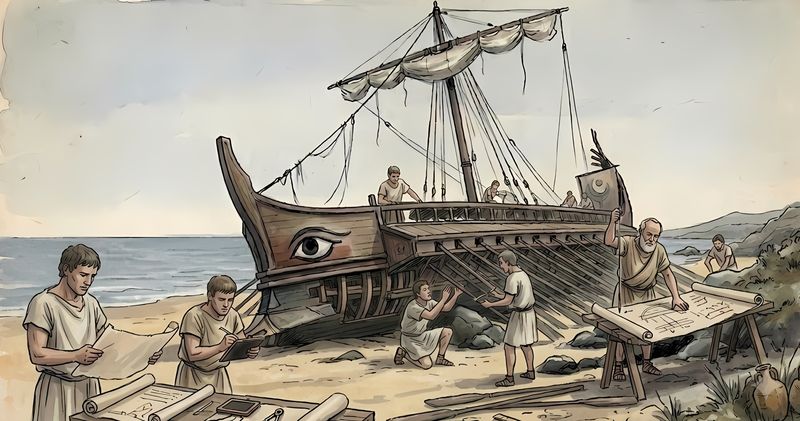
In 260 BC, the fourth year of the war, Rome was winning on land in Sicily while every Carthaginian fortress still standing was supplied from the sea. Rome built a hundred quinqueremes and twenty triremes on the pattern of a captured Carthaginian shipn.1, fitted them with the corvusn.2, and at Mylae the consul Gaius Duilius won Rome’s first victory at sea. n.1 The captured ship ran aground at the straits during Rome’s first crossing in 264 BC (1.20.15); the cold open shows it without a date, in the order Polybius tells it. n.2 Polybius names no inventor for the corvus: it was “suggested to them” (1.22.3). The episode gives it to someone in Rome whose name the sources did not keep.
For tonight
The Battle of Ecnomus, 256 BC, narrated for sleep
Four years later, Rome puts to sea with three hundred and thirty ships. Told slowly, for the night. 1:01:53.
What Polybius says happened
Polybius, Histories 1.20 to 1.23, in Paton’s translation. The episode keeps this order.
With the war dragging on, Rome undertook for the first time to build ships: a hundred quinqueremes and twenty triremes.
1.20.9
Its shipwrights had never built a quinquereme, so a Carthaginian ship that had run aground in the straits became the model for the whole fleet.
1.20.10, 1.20.15
While the ships were building, the crews learned the stroke on benches set out on dry land.
1.21.1 to 1.21.2
The consul Gnaeus Cornelius Scipio went ahead with seventeen ships and was drawn to Lipara, where Boodes shut him in the harbour by night with twenty Carthaginian ships. At dawn his crews fled ashore and he surrendered.
1.21.4 to 1.21.8
Gaius Duilius, who commanded the army on land, was called to the fleet, and the ships were fitted with the corvus, a device suggested to them.
1.22.1 to 1.22.3
Off Mylae the Carthaginians came out with a hundred and thirty ships. The first thirty to close were held fast by the bridges and taken with their crews, fifty were lost in all, and their commander Hannibal got away in a small boat.
1.23.3 to 1.23.10
What is contested
- The fleet built in sixty days is Pliny’s tradition, not Polybius: a fleet afloat on the sixtieth day after the timber was felled (Natural History 16.192). The episode gives it as tradition.
- The Columna Rostrata that lists Duilius’s captures is an early imperial restoration with deliberately old-fashioned Latin, not the column of 260 BC. The episode gives its numbers as the monument’s boast and follows Polybius for the battle.
- Where the quinquereme came from is split in the ancient sources: Pliny credits Carthage, Diodorus credits Dionysius I of Syracuse.
What the check changed before release
On , before release, the script of this episode was checked against Polybius. Seven lines of narration changed; the pictures were left as drawn.
From the series’ fact-check record, in its own words. Errors found after publication go in the ledger instead.
-
Draft.
“Rome just won the land war in Sicily”Episode. “Rome is winning the war on land in Sicily”
The war on land ran on to 241 BC, and Carthage still held the west of the island (1.20.1 to 1.20.7).
-
Draft.
“Two years into the war”Episode. “Four years into the war”
The war began in 264 BC, so 260 was its fourth year.
-
Draft.
“crossed to Sicily two years before”Episode. “four years before”
The crossing was made in 264 BC (1.20.13 to 1.20.14).
-
Draft.
“both consuls were sent to sea”Episode. “Rome sent its new fleet ... and put the war in the hands of its two consuls”
Duilius held the army on land, and took the fleet only after Scipio was captured (1.21.4, 1.23.1).
-
Draft.
“slipped out of Agrigentum by night the year before”Episode. “by night when the city fell”
Agrigentum fell in 262 BC, two years before Mylae.
-
Draft.
“for the first time in living memory, is not safe”Episode. “for the first time, is not safe from the sea”
Pyrrhus had threatened Italy about twenty years earlier; what was new was raiding from the sea (1.20.7).
-
Draft.
“A Roman climbs aboard and measures it”Episode. “A shipwright from Rome’s Greek allies”
Polybius names no one who drafted the fleet and calls Rome’s own shipwrights inexperienced (1.20.10); the first boats came from the Greek allies (1.20.14).
See also
How the First Punic War began, 264 to 262 BC
Episode 1: why a Roman army was in Sicily at all.
The episode before
23:37
The First Punic War, narrated for sleep
All twenty-four years in one slow reading, for the lights off.
Another night
1:07:54
Sources
- Polybius, Histories 1.20 to 1.24, translated by W. R. Paton (Loeb Classical Library, 1922), read in the LacusCurtius text; the fact-check of 21 June 2026 ran against it
- Pliny the Elder, Natural History 16.192: the sixty-day tradition
- Cicero, On Old Age 44: the honour voted to Duilius for life
- The Columna Rostrata inscription: the monument’s own tally